HVAC&R and NASRC Student Experience
April 21, 2026
by Steffen Peuker
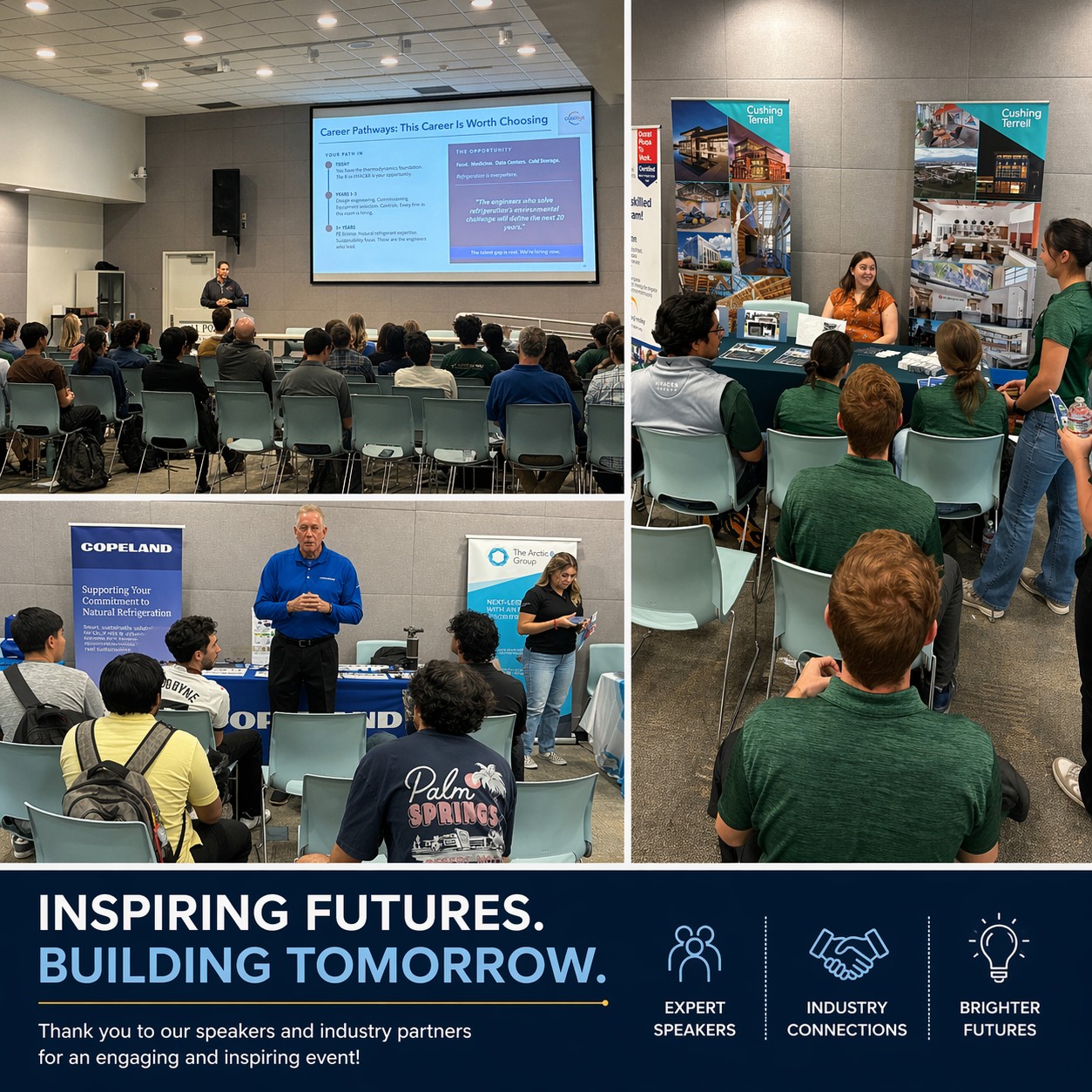
In partnership with the North American Sustainable Refrigeration Council (NASRC), the Cal Poly Student ASHRAE Branch and the ME HVAC&R program, Cal Poly’s inaugural HVAC&R and NASRC Student Experience brought together 100 students and 23 industry professionals for a day of hands-on learning, career exploration, and networking. Students learned foundational refrigeration design concepts, practical tools, and real-world industry applications while gaining exposure to sustainable, decarbonized refrigeration solutions and connecting with industry experts, employers, and peers.
Second year mechanical engineering student and incoming ASHRAE club officer Andrew Chapin shares his experiences at the event below:
Refrigeration Engineering?
A career with accelerating growth, well-paying jobs, the ability to live anywhere in the country, and solving issues like climate change and world hunger daily? Welcome to the little $54 billion-dollar industrial refrigeration industry. In partnership with Cal Poly Student ASHRAE, the North American Sustainable Refrigeration Council hosted a training and networking event attended by dozens of students and industry engineers to learn more about the future wonders and challenges of sustainable refrigeration.
Here are some of my highlights from this fantastic event:
Why do I care?
Over 14% of all global food production is wasted—enough to feed over 1 billion people—and a majority of these losses come from inadequate refrigeration. Refrigeration is needed everywhere, from post-harvest, to food processing, to distribution and logistics, to food service, to retail, to transportation…it’s a lot…and that’s just food! Refrigeration is also essential in many chemical, manufacturing, and medical processes. Refrigeration engineers are critical in designing and maintaining these systems that make our modern lifestyles possible.
Nature knows best?
In the 1930s, synthetic refrigerants (the fluid that carries heat within a refrigeration system) were developed to be nonflammable and stable, like Freon (known in industry as R-12). However, it is now known that these refrigerants have significant negative impacts on global warming and can cause cancer. This is where Bruce Nelson and natural refrigerants come in. Nelson, president of a refrigeration equipment manufacturer for over 20 years, is one of the industry’s leading champions for “natural refrigerants.” These fluids, like propane, ammonia, and CO2 have a promising future for reducing the cold chain’s impact on climate change, which currently contributes around 4% of global greenhouse gas emissions.
AI!
AI is starting to play a crucial role in the refrigeration industry. The average refrigeration system loses 25-35% of its refrigerant per year through leaks. This is not only an environmental disaster, but expensive too. Refrigeration operators are continuing to invest in AI leak detection systems and energy efficiency optimizations to reduce costs. One real-world example comes from Australia, where Woolworths Group deployed predictive analytics across its supermarket network to detect refrigerant leaks earlier and optimize energy performance; Woolworths reduced refrigerant leaks by over 35% [1]. These stories will only become more common as operators continue to see energy and refrigeration savings, and an upcoming refrigeration engineer would do well to learn as much as possible about the practical implementation of these systems.
Want to get hired?
Perhaps the most valuable piece of advice for someone in my current stage of life (i.e., a college student) comes from Ben Rosenzweig, the president of Professional Solutions at CoolSys. While conversing over lunch, he advised that any young engineer looking into the MEP profession should take the FE exam (a necessary precursor to a PE license) during school or right after graduation. He has seen many competent engineers struggle with the FE fundamentals, all of which we learn in university, having been out of school for many years. When hiring, Rosenzweig sees an FE as a strong plus, and is more likely to invest in someone who has both taken the initiative on their own and is on a fast-track to the PE license necessary to approve official drawings. The Cal Poly Student ASHRAE club has its own FE study program, which both provides study material and will reimburse the entire $225 fee!
If you are interested in learning more about refrigeration and other engineering opportunities in the HVAC&R industry, come by the Cal Poly Student ASHRAE club meetings from 11:10AM-12PM Thursdays in Engineering 13, room 124!