Evolution of Data Center HVAC Design and Energy Efficiency
Overview
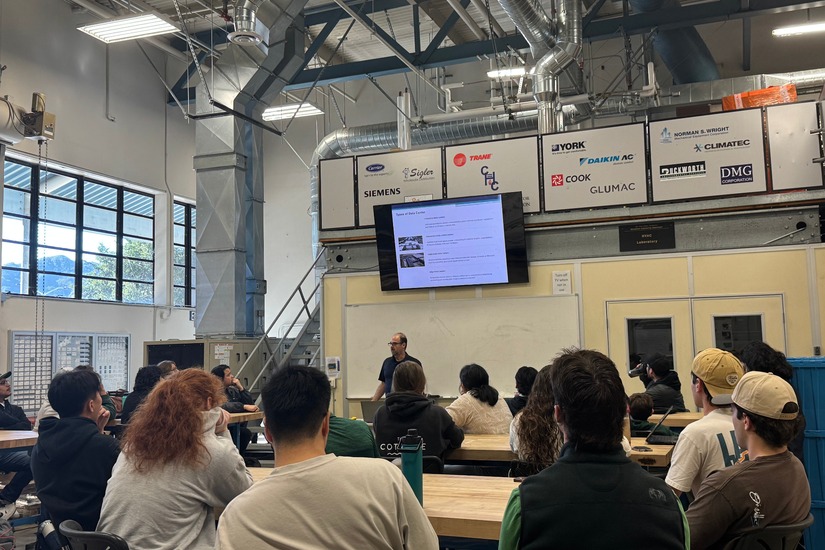
Mehrdad Alipour, PE, from Therma led a workshop on modern data center HVAC design. He explained how HVAC has changed as computing demand has grown. He also covered higher power densities and the fast rise of cloud and AI.
Mehrdad connected core mechanical engineering ideas to real site conditions. He showed how HVAC supports reliability, efficiency, and nonstop operation. Students learned how HVAC engineers help run some of the world’s most demanding facilities.
How Data Centers Reached Today’s Cooling Needs
The session opened with a quick history of computing. It moved from early mechanical devices to today’s hyperscale data centers. Mehrdad showed how power use and cooling loads increased with each leap in technology.
He described a data center as a full engineering ecosystem. Power, cooling, and networking must run 24/7. Teams also design for redundancy, reliability, and easy maintenance.
Thermal Management: Air Cooling and Liquid Cooling
Next, the workshop focused on thermal management. Mehrdad compared air-cooled and liquid-cooled approaches. He explained airflow-based cooling and water-based systems. He also reviewed direct-to-chip liquid cooling.
He used simple calculations and real examples. These showed why liquid cooling now matters for dense AI and HPC racks. The session also covered airflow containment and rack layout. Mehrdad discussed redundancy levels from N+1 through 2N+1. He also reviewed ASHRAE environmental envelopes.
Efficiency, Commissioning, and Real-World Examples
The workshop covered key efficiency metrics, including Power Usage Effectiveness (PUE). Mehrdad explained how engineers measure and improve energy performance.
He also walked through commissioning steps. These ranged from factory tests to live-load integrated systems testing. He explained how teams verify performance in real conditions, not just on paper.
Mehrdad shared two case studies from operating data centers. One site used air cooling. The other used water cooling. He highlighted commissioning lessons, CFD modeling, economizer operation, and long-term operating challenges.
Industry Trends and Takeaways
The session ended with a discussion on current trends. Topics included liquid cooling adoption and water quality management. Students also discussed reliability risks and how teams reduce them.
Mehrdad emphasized coordination across disciplines. Mechanical, electrical, and IT teams must work closely. Students left with practical insight into how HVAC engineers design and support mission-critical data centers.